
Introducing Dojo: The Operating System for Independent Corporate Trainers
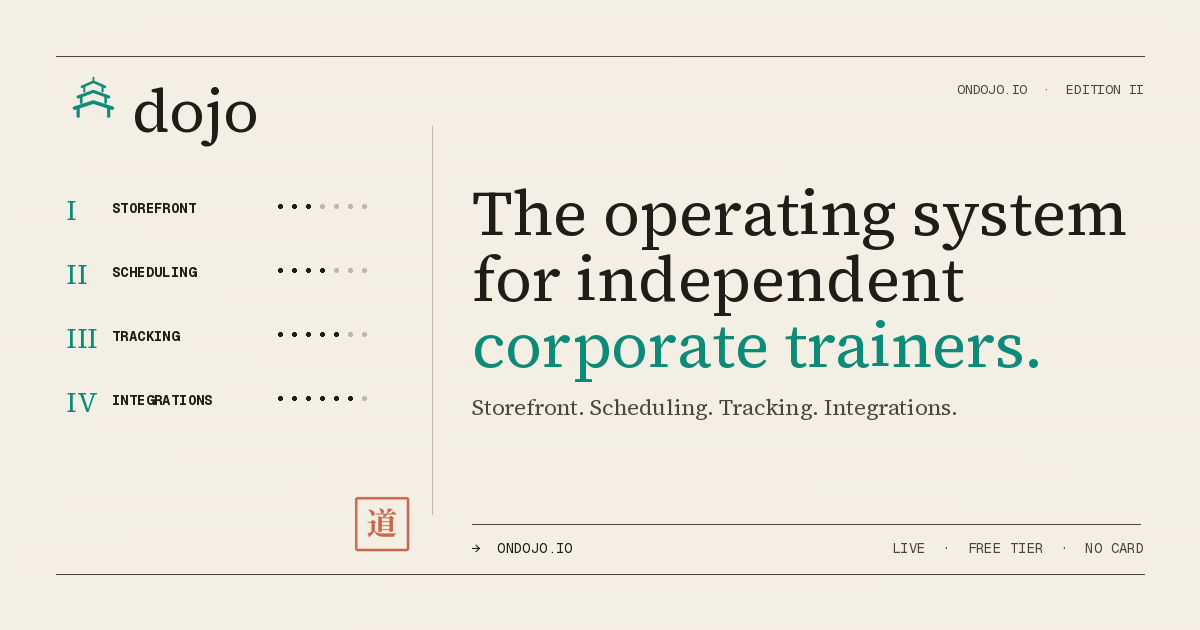
We're launching Dojo! Dojo is the operating system for independent ILT and VILT trainers — a link-in-bio storefront, pooled scheduling, attendee tracking, and QuickBooks built in. Free until corporate clients roll in.
Update, 24 October 2026: Dojo now sells to individuals as well as companies, and our plans have changed. Read what’s new and see current pricing.
Introducing Dojo: The Operating System for Independent Corporate Trainers
If you run instructor-led training for companies — compliance, safety, leadership, sales, software adoption — you already know the secret nobody warns you about: delivering the workshop is the easy half. The hard half is everything around it. The booking link. The scheduling. The roster. The invoice with the right PO number. The follow-up paperwork a client needs to claim a training grant.
Today we're launching dojo — the operating system for independent corporate trainers. One platform that runs the business side of training, so you can go back to the part you're actually great at: being in the room. This is both a how-to on running a modern ILT and VILT practice and an introduction to the tool we built to make it stop hurting.
If you've ever described yourself as a "trainerpreneur" — half teacher, half small-business owner — dojo was built for you.
What ILT and VILT actually are (and why independents own this market now)
Instructor-led training (ILT) is exactly what it sounds like: a live, expert-led session, traditionally in a classroom. Virtual instructor-led training (VILT) is the same thing delivered live online, instructor and learners in different places. Both are scheduled, live, and human — which is exactly what makes them resilient in an era of self-paced video courses and AI tutors. People still pay a premium for a real expert in a real (or virtual) room.
The numbers back it up. Roughly 94% of L&D professionals now use VILT as part of their training mix, and large companies reach for it about 39% of the time, making it their single most-used delivery method. Moving one course from a classroom to VILT can save a company between $9,550 and $15,870 — which is why corporate buyers keep saying yes.
Here's the part that matters for you: a growing share of that training isn't delivered by in-house L&D teams. It's delivered by independent corporate trainers — solo practitioners and one-to-three-person practices hired session by session. You bring the expertise; the company brings the room and the budget. It's a great business. The tooling around it, until now, has been a mess.
The trainerpreneur's real problem: you trained to teach, not to run a back office
Most independent trainers run their entire operation on four tools that don't know each other exist:
- A scheduling tool (Calendly) for picking times.
- A payment tool (Stripe, or a card reader) for getting paid.
- An invoicing or accounting tool (QuickBooks, or a Word template) for the AP department.
- A spreadsheet and a Google Doc for the attendee roster and the completion certificate.
Calendly doesn't know who paid. Stripe doesn't know the PO number. QuickBooks doesn't know who showed up. And none of them know that you're trying to bill three different companies for the same Tuesday morning. Every booking becomes a manual relay race between five browser tabs — and every hour you spend stitching them together is an hour you didn't spend selling or teaching.
The software market hasn't helped, because almost none of it was built for your buyer. HoneyBook is built for wedding photographers and creative freelancers selling to consumers. Bookwhen and Punchpass are built for yoga studios and pottery classes. Arlo and Administrate are genuinely good — but they're built for training organizations with $105–$240/month budgets and admin teams, not a solo trainer running two sessions a quarter, and reviewers regularly flag limited storefront customization and weak North American integrations. Maven is a marketplace for star tech instructors teaching $1,500 cohorts to individuals.
None of them are built for the trainer who sells live ILT and VILT to procurement departments. That gap is the entire reason dojo exists.
What a corporate trainer OS actually does
dojo isn't a booking tool, a scheduler, or an invoicer. It's the operating system that ties all of those jobs together for one specific person — the independent corporate trainer — around one shared model of your programs, your sessions, your attendees, and your money. Here are the four pillars, in the order you actually use them.
1. Your link-in-bio training storefront
Generic link-in-bio tools (Linktree, Stan, Beacons) were built for creators selling digital products to consumers. dojo gives you a training storefront instead: `go.ondojo.io/your-name` is a page companies can actually *ook corporate training from — your programs, your credentials, your prices, your availability.
Drop it in your email signature, your LinkedIn bio, your proposal footer. When an L&D manager is shopping for a safety workshop, you're one click from booked instead of one more email thread to chase. It's the difference between a link that lists what you do and a storefront that closes the sale.
2. Scheduling that pools multiple companies into one session
This is the mechanic no other booking tool ships, and it's the heart of the product. A small company can't fill a workshop on its own — and a four-person private booking barely covers your day rate. dojo lets several businesses share the same session, each taking the seats it needs. You deliver once, to a full room, and each company is invoiced separately.
For VILT especially, this is transformative: there's no physical room cap, so a virtual session can pool buyers from anywhere. You schedule public or private sessions, set the seat count, and let small bookings add up to a full house.
3. Attendee tracking, from booking to completion
Every booking builds its own roster automatically. You follow each seat through the full lifecycle — **booking → attendance → evaluation → completion** — and dojo ships the reimbursement-ready paperwork at the end: an attendance ledger and a course outline a client can hand straight to a grant program or an internal compliance auditor. When a customer asks "who finished what?", the answer is one screen away instead of a spreadsheet archaeology project.
4. The integrations that hold it together
Invoices sync two ways to QuickBooks, tax-ready, so you're not re-keying line items at year-end. Virtual sessions get a Google Meet link generated automatically. The back office runs without you babysitting it. (Xero, Zoom, and Calendly migration are on the roadmap.)
The pooling math: the most persuasive number in your business
Here's why pooled scheduling changes the economics of an independent practice. Picture a single half-day workshop at a **$180 per-seat** rate:
- A private booking with one small company — 4 seats — earns you $720. Barely worth the prep.
- A pooled session with the same room filled to 18 seats across four companies earns you $3,240. Same delivery. Same Tuesday. Same prep.
That gap — $720 versus $3,240 for the same hours of work — is the difference between a side hustle and a business. Every other tool forces you to choose between an empty private room or a marketplace that takes a cut and owns your customer. dojo lets you fill the room yourself, keep the relationship, and invoice each buyer cleanly.
Built for how companies actually pay
Trainers don't get paid like freelancers. You get paid like a vendor — and that means dealing with an accounts-payable department that has rules. dojo's Business tier speaks their language natively:
- PO numbers as a first-class field, not a workaround stuffed into a memo line.
- Net-15, net-30, and net-60 terms as real workflow primitives, so the invoice an AP department receives is one it can pay on the first try.
- Audit-ready paperwork and a two-way QuickBooks sync so your books and your client's books agree.
This is also where the grant money lives. In Canada, programs like the Canada Job Grant and provincial training credits (and WSIB-recognized safety training) reimburse companies for training spend — but only if the paperwork is right. dojo is built Canada-first and jurisdiction-aware, with the attendance and completion records those claims require generated automatically. It's localized in English and French (ondojo.io/fr), so a Montréal trainer is as covered as a Toronto one.
Why now: the timing for an independent trainer OS
Three things make this the right moment to move your practice onto purpose-built software.
Practice.do shut down on November 3, 2025. The most popular "operating system for solo professionals" is gone — no read-only mode, no pivot, just a farewell page — leaving thousands of coaches, consultants, and trainers actively shopping for a replacement. Most of the alternatives being pushed (Paperbell, CoachVantage, Simply.Coach) are coach-to-individual platforms with no PO numbers, no net-30, and no multi-company billing. If your work is corporate, dojo is the Practice.do alternative built for your actual buyer.
HoneyBook raised prices roughly 89% on its entry tier in 2025, alienating the affordability-driven freelancers who anchored its base — while still offering no real B2B billing workflow.
The org-grade tools start at $105+/month and assume you have an admin team. dojo starts free. You're an Arlo alternative for solo trainers who don't need — and shouldn't pay for — a full training-provider suite.
The window is open. The trainers leaving these platforms are looking for a home right now.
Who dojo is for (and who it isn't)
dojo is for independent corporate trainers and facilitators running compliance, safety, leadership, sales, and skills workshops — solo or in small practices — who bill other businesses. It's for coaches and consultants with corporate clients, and for ex-Practice.do users whose work is B2B.
It is not for wedding photographers, yoga studios, or individuals shopping for a course to upskill themselves. Those buyers don't have an AP department — and the whole point of dojo is that yours do. If your invoices need a PO number, you're in the right place.
Pricing: free until corporate clients start rolling in
- Hobby — $0/month, 2.9% transaction fee. Your booking link, unlimited programs and sessions, pooled scheduling, cohort management, rosters, and Stripe card payments.
- Business — $44/month + 0.9%. Everything in Hobby, plus B2B invoicing with PO numbers, net-15/30/60 terms, and the two-way QuickBooks sync.
No credit card to sign up. The free tier is forever, not a trial. You don't pay a subscription until the corporate clients — and their POs — start rolling in.
Get started
Spinning up your training storefront takes a few minutes. Claim your link at **[go.ondojo.io/your-name](https://app.ondojo.io/sign-up)**, list your first program, and share it on your next proposal. The next time a company asks "do you have a link where we can book?", you'll have a real answer — and a real storefront doing the selling for you.
The trainer delivers. dojo runs everything else.
Frequently asked questions
What's the difference between ILT and VILT?
ILT (instructor-led training) is live, expert-led training delivered in person, usually in a classroom. VILT (virtual instructor-led training) is the same live, scheduled format delivered online, with instructor and learners in separate locations. dojo supports both — and auto-generates a Google Meet link for your virtual sessions.
What is a "trainerpreneur"?
It's the blend of "trainer" and "entrepreneur" — an independent corporate trainer who not only delivers workshops but runs the whole business around them: marketing, booking, billing, and follow-up. dojo is the operating system for that second job.
Is dojo a good Practice.do alternative?
For corporate trainers, yes. Practice.do shut down on November 3, 2025, and most recommended replacements are built for coaches billing individuals. dojo is built for trainers billing companies — with PO numbers, net-30 terms, multi-company session billing, and QuickBooks sync that coach platforms don't offer.
How is dojo different from Arlo or other training management software?
Tools like Arlo and Administrate are built for training *organizations* with admin teams and budgets starting around $105–$240/month. dojo is built for the *individual* trainer — a free tier, a personal link-in-bio storefront, and pooled multi-company scheduling that org-focused suites don't ship.
Can multiple companies really share one training session?
Yes — it's dojo's core mechanic. Several businesses can pool into the same session, each taking the seats they need and each invoiced separately. You deliver once to a full room instead of running thin, money-losing private bookings.
Does dojo work for trainers in Canada?
dojo is Canada-first and jurisdiction-aware, with attendance and completion records formatted for programs like the Canada Job Grant and WSIB-recognized training, and it's fully localized in French at ondojo.io/fr.